You are in a hurry, you pull the handle – and the door will not budge. Or the car moves a few centimetres and stops, because the handbrake has frozen on. The first proper frost almost always arrives unannounced, and that is exactly when a small thing turns into an expensive repair. The worst part is what most drivers do first: pull harder.
First work out what has actually frozen
Everything else follows from that. The German automobile club ADAC suggests a simple test: if the key turns in the lock or the central locking clicks but the door still will not open, the rubber seals have frozen. If the key will not go into the lock at all or will not move, moisture has frozen inside the lock itself.
A third possibility: you get in without trouble, but the car will not pull away – usually a frozen parking brake. And a fourth: wiper blades stuck to the windscreen that try to drag the sheet of ice with them the moment you switch them on.
A frozen door: push, do not yank
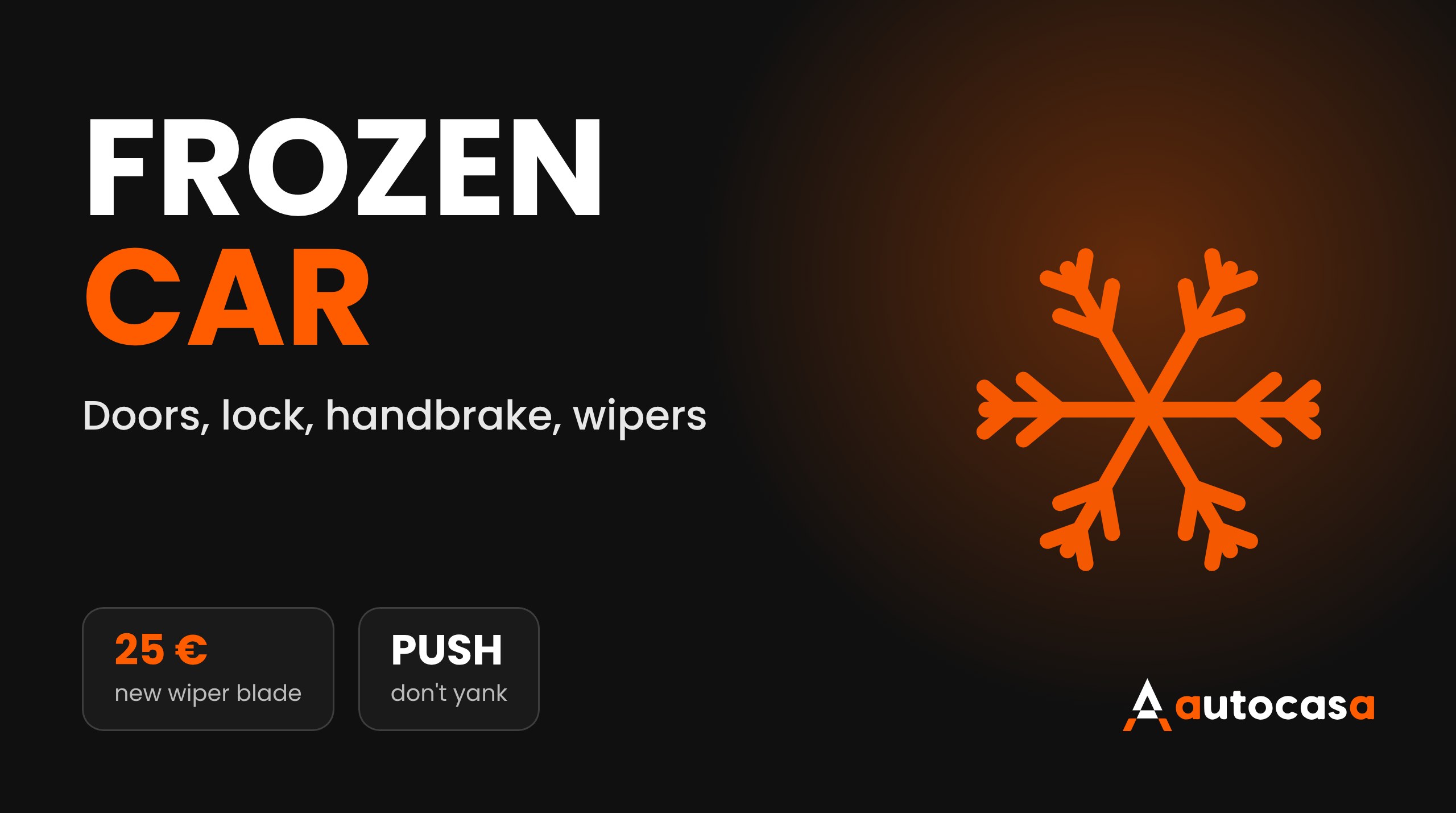
With frozen seals the instinct is to pull with both hands. That is precisely what ADAC advises against: the rubber can tear or be pulled out of the frame, and the thin door skin can deform. A door seal is only cheap while it is still intact.
The opposite approach works: press the door inwards first and tap gently with your palm around the seal. The ice in the gap cracks and the door comes free. If that does not help, try another door – the passenger door or the boot lid will often do – and open the car from the inside, where the force is easier to control.
Leave the boiling water in the kettle. It damages the paint, and the sudden change in temperature can crack the glass. Lukewarm water along the door frame is a last resort, and only on the metal, never on the glazing – and the seals must be wiped dry straight afterwards, or they will freeze solid again within minutes. A heat gun or an open flame has no place near a car.
When the key will not go into the lock
There is a cheap solution the size of a marker pen: lock de-icer spray. Give it a few minutes after spraying and the key will turn. There is only one catch – the spray helps only if it is not locked inside the car. It belongs in a bag, a jacket pocket or on the shelf by your front door, not in the glovebox.
Warming the metal part of the key with a lighter is an old trick that today makes sense only on older cars with a purely mechanical key. With a transponder key, a remote or a keyless system you risk the electronics – and a new key including programming runs into several hundred euros.
Handbrake: in frost, better to leave it off
A classic mechanical handbrake works through a cable in a sheath. If moisture gets in – a drive through wet snow and road salt is enough – and the temperature drops below zero, the cable and the brake shoes can freeze in the applied position. In the morning the car either will not move at all, or drags a locked axle.
- Parking on the level with frost forecast: leave the handbrake off and select first gear, or P on an automatic. On a slope that is not enough – there, apply the brake and chock a wheel or turn the wheels towards the kerb.
- If it has already frozen: start the engine, let it run for a while and try rocking the car very gently back and forth, or apply and release the brake a few times. According to ADAC experts a firm kick to the rear tyre also helps – the handbrake usually acts on the rear axle.
- What not to do: no heat gun, no open flame. A hairdryer on an extension lead is the safer route if you have a socket within reach.
- If it keeps happening: a workshop can re-grease the cable. If the moisture has settled in for good, only replacement helps – otherwise it will freeze again in the next cold snap.
- Electric parking brake: many cars apply it automatically when the engine is switched off. It can be released with a button, but check the procedure and any limitations in the owner’s manual for your model.
Wipers: service position instead of tearing them loose
Frozen wipers are the cheapest problem on this list – and also the one drivers most often inflict on themselves. You sit down and switch the wipers on out of habit before the screen has cleared. The soft rubber tears, and the result is smearing that genuinely dazzles you against low winter sun. A new blade costs around 25 euros on average according to ADAC, so double that for a pair.
If you park outside, lift the arms off the glass. Most recent cars have a service position for this – on Škoda models you trigger it by pushing the wiper stalk down for more than a second within ten seconds of switching off the ignition. Do not slide paper or cardboard under the blades: both soak up water and freeze just as firmly. A windscreen cover does the job far better.
Fifteen minutes of prevention that lasts all winter
- Seals: clean them and treat them with a silicone- or glycerine-based rubber care product. The film stops them freezing to the frame and protects the rubber from drying out. Butter, lard or tallow are not suitable – grease attacks rubber over time and attracts dirt. Do not forget the boot lid.
- Locks: lubricate with oil or graphite, ideally before the first frost.
- After the car wash: open and close every door and wipe the seals dry. Water left sitting in them is the most common cause of the morning surprise.
- Washer fluid: top up with winter mix in good time and do not mix it with summer fluid. Empty the line to the rear screen too, where summer fluid freezes first.
- Lock de-icer goes in your pocket, not in the car.
What to check when buying a used car in winter
For a viewing, frost is actually an ally – it reveals what summer hides. Run a finger along the door seals: cracked, hardened rubber means the car stood outside for years with no care. Try every door including the boot, apply and release the parking brake, then drive the car a short distance. Look at the wipers – smears and juddering are small things, but they say a lot about how the owner treated the car.
If you are the one selling, the logic runs the other way: clean, treated seals, working wipers and topped-up winter washer fluid cost a few euros and show a buyer immediately that the car has been looked after. Listing on AutoCasa is free, with no sales commission and no limit on the number of adverts – from cars and motorcycles to vans, trucks, buses and trailers, and on to spare parts, wheels and tyres or bicycles.
And when you photograph the car, do it in daylight and after a wash. Winter shots taken at dusk in a snow-covered car park sell worst of all.
The advice in this article draws on guidance from the German automobile club ADAC and technical tips from the manufacturer Škoda Auto, current as of 24 November 2026. The article is written for buyers and sellers in Slovakia and Czechia. Always check the procedure for the parking brake and wipers in your own vehicle’s owner’s manual.


 Slovenčina
 Čeština
 Angličtina
 Nemčina
 Poľština
 Slovinčina
 Ruština
 Taliančina
 Maďarčina
 Francúzština


Zatiaľ tu nie sú žiadne komentáre. Buďte prvý!