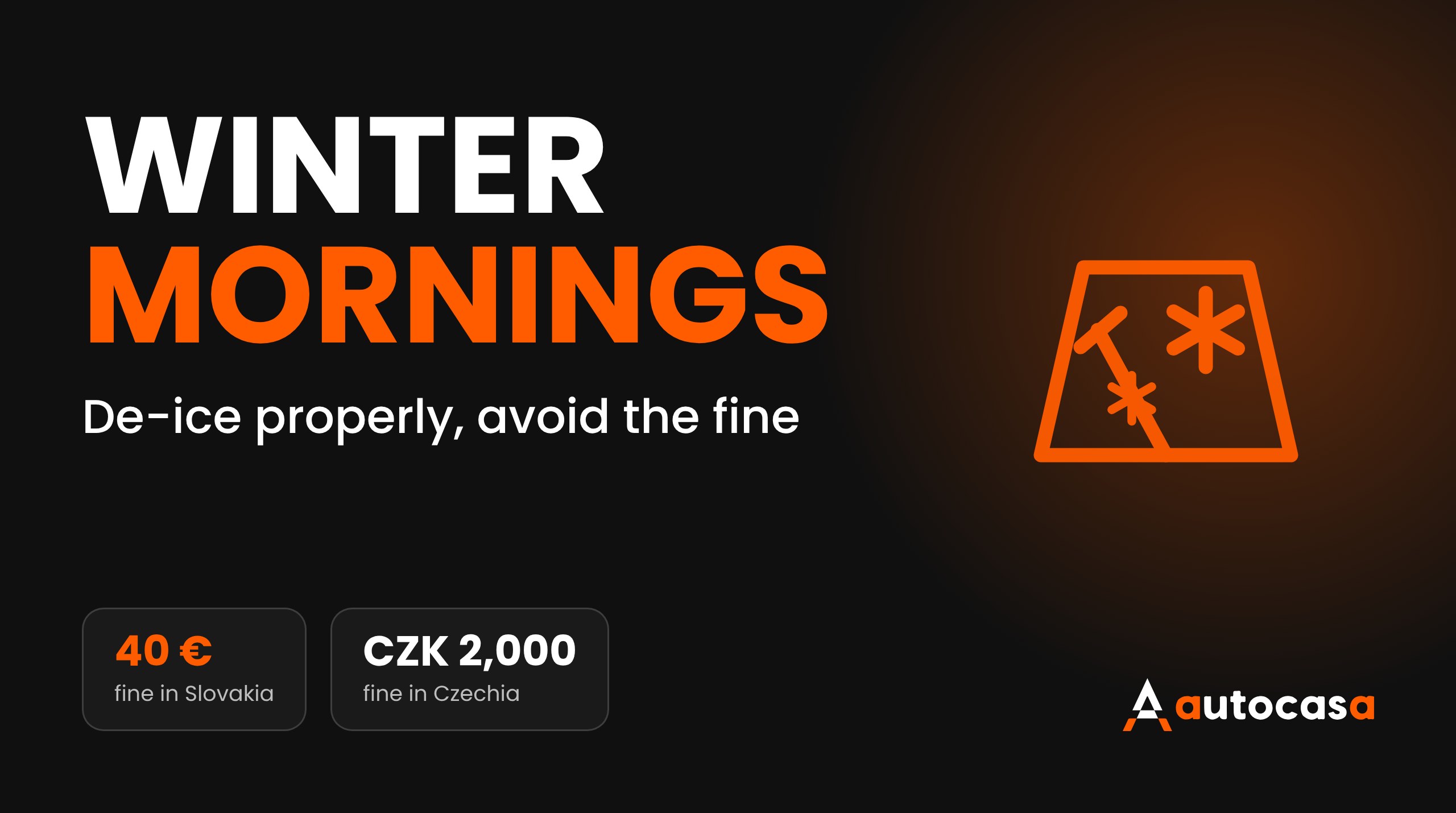
The first frosty mornings always arrive before most of us dig the ice scraper out of the garage. That is exactly when drivers make the most mistakes: hot water on the windscreen, wipers switched on over a sheet of ice, and setting off with a cleared patch the size of a palm. It takes a few minutes to do it properly, and those minutes decide both your safety and whether you pay a fine.
A snow-covered car is an offence in Slovakia and in Czechia
If you drive in Slovakia – for work, on the way to the Tatras, or in a car you bought there – Slovak rules apply to you. The Slovak Road Traffic Act (No. 8/2009 Z. z.) states in Section 38(4) that before setting off the driver must remove from the vehicle and its load any chunks of ice and snow that could come loose while driving. That covers not only the windscreen but also the roof, bonnet, boot lid, lights and number plates. The Slovak Ministry of the Interior gives the penalty for this as 40 euros.
In Czechia the wording is even more specific. Act No. 361/2000 Sb., Section 5(2)(i), prohibits driving a vehicle whose windows are covered with dirt, snow or frost obstructing the view, and equally a vehicle from which ice could fly off. Section 32(5) additionally requires that the light-emitting surface of the lamps is neither covered nor dirty. The fine is higher than in Slovakia: up to CZK 2,000 (roughly 80 euros) on the spot, and CZK 1,500 to 2,500 (roughly 60 to 100 euros) in administrative proceedings.
Snow on the roof is the treacherous one. Under hard braking it slides onto the windscreen and takes away your entire view for a second; when you pull away, it lands on the car behind you. A slab of ice that comes off at a hundred kilometres per hour can break someone else’s windscreen – and the claim goes to your insurer, not theirs.
How to de-ice the glass quickly without damaging it
The cheapest method is still the oldest one: a plastic scraper and a little patience. De-icer spray speeds the job up, but it also needs a few tens of seconds to break the ice down. Point the heating at the windscreen before you start scraping – by the time you have walked around the car, the glass has warmed from the inside and the ice lets go.
- Never hot water. The temperature shock can crack the glass, especially if there is already a stone chip in it. Overnight, a small chip turns into a crack across half the windscreen.
- Wipers are not scrapers. Running them over frozen glass tears the rubber and, at worst, burns out the wiper motor.
- Forget the bank card and the CD case. Hard plastic with a sharp edge leaves micro-scratches that scatter oncoming headlights at night.
- Clear the whole car, not just a porthole. The roof, lights, mirrors, number plate and the parking sensors in the bumper.
- Wipe the glass dry on the inside. Moisture in the cabin is why the windows mist up again two minutes later. A microfibre cloth and the air conditioning switched on, which dries the air, solve it.
Washer fluid and wiper blades: the two things people forget
Plain water in the washer bottle is an expensive winter experiment. It freezes, splits the hoses and sometimes the pump itself, and the repair costs many times more than a canister of winter fluid. Buy one rated to at least −20 °C; for trips into the mountains, −30 °C is worth it. Watch out for concentrates – diluted at the summer ratio, they lose their frost protection.
Wiper blades are a consumable and manufacturers recommend replacing them roughly once a year. Autumn is the logical moment: after the summer sun the rubber has hardened, and that shows up most in rain and in the salt spray thrown up by other cars. If the blades judder, squeal or leave streaks, do not take them into winter. In a hard frost, lift them off the glass before you park, or slide a piece of cardboard underneath so they do not freeze on.
Engine idling while you scrape? The law says no
Starting the engine and then going out to scrape has two drawbacks. The first is legal: the Slovak Road Traffic Act prohibits in Section 4(2)(m) leaving the engine of a stationary vehicle running unnecessarily. In Czechia the same ban sits in Section 7(1)(c) of Act No. 361/2000 Sb. The second is mechanical: a cold engine at idle warms up slowly and unevenly, fuel washes the oil film off the cylinder walls and thins the oil. A modern engine reaches temperature fastest, and with the least wear, by being driven gently at low revs.
So the right order is the other way round: sweep off the snow and scrape the ice first, then start up and drive away – keeping the revs low for the first few kilometres.
Buying a used car? Check these six things before winter
Viewing a car in October has one advantage you do not get in July: everything you will need in winter can be tried out on the spot.
- Heated rear window and mirrors – switch them on and touch the glass after a minute. A broken element shows up as a stripe that stays cold.
- Heater and demister – the windscreen vents must blow genuinely hot air. A lukewarm flow points to air in the cooling system or a blocked one.
- Air conditioning – in winter you need it to dry the air, not to cool it. If it does not work, misted windows become a daily routine.
- Washer jets and reservoir – check the spray direction, the flow, and that the bottle is not leaking.
- Windscreen and seals – even a small stone chip spreads in frost. Perished door seals mean frozen doors and damp in the cabin.
- Condition of blades, battery and suspension – on a used car these are the classic items to negotiate the price on.
The car and the winter kit in one place
If winter is your reason to change something, AutoCasa.sk lists cars and vans, motorcycles and trailers, plus the spare parts and wheels and tyres categories – exactly what people look for most before winter. Listing is free, with no sales commission and no limit on the number of adverts. Promoting a listing is optional and starts at 1.50 €.
If you are selling instead, autumn is a good time. Buyers are looking for a car that will handle winter, so write in the advert what is already done: new blades, battery condition, the date of the last oil change, a valid roadworthiness test, or a set of winter tyres included. A few extra lines will save you dozens of messages.
The information in this article is based on Slovak Act No. 8/2009 Z. z. on road traffic and Czech Act No. 361/2000 Sb. as in force in October 2026. It applies to Slovakia and Czechia – other countries have their own rules, which are worth checking before you travel.


 Slovenčina
 Čeština
 Angličtina
 Nemčina
 Poľština
 Slovinčina
 Ruština
 Taliančina
 Maďarčina
 Francúzština


Zatiaľ tu nie sú žiadne komentáre. Buďte prvý!