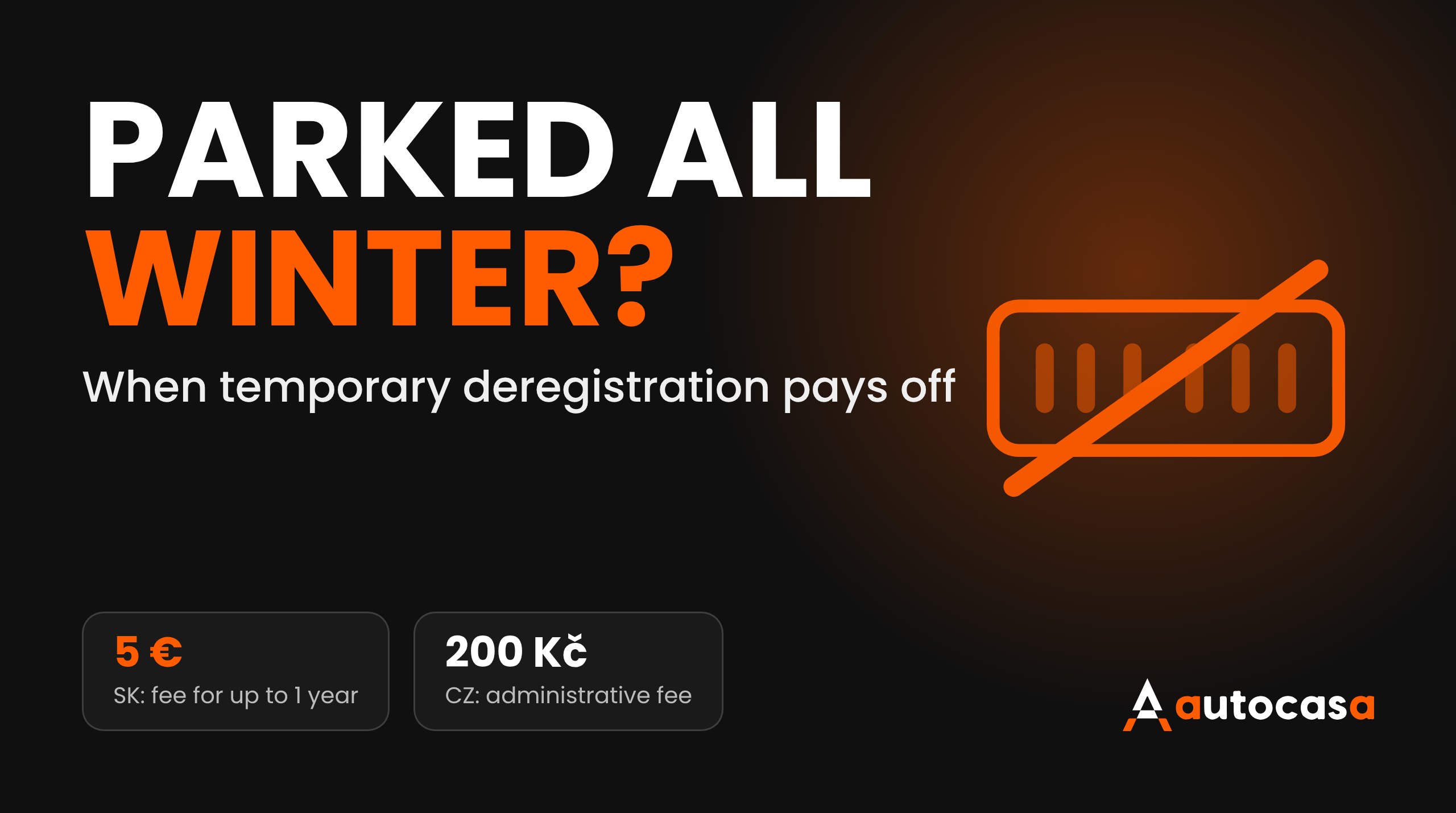
The second family car, the motorcycle sitting in the garage until April, the trailer you pull out once a year. All of these have one thing in common: even if they do not cover a single metre all winter, you keep paying their compulsory insurance. Temporary deregistration is the legal way to switch that cost off for a few months. Here are the rules, deadlines and fees that apply in Slovakia and Czechia.
What temporary deregistration actually means
In Slovakia the matter is governed by Act No. 8/2009 Z. z. on road traffic. The vehicle stays yours and stays in the register, but for the agreed period the authority marks it as withdrawn from road traffic. During that time it must not use public roads — not even for one short trip to the workshop.
You file the application at the traffic inspectorate (dopravný inšpektorát) or through the electronic service. Bring your ID, the registration certificate parts I and II, and to be safe the number plates as well — at the counter they will tell you what is kept and what stays with you. Filing electronically is usually cheaper; check the current rate before you apply.
What it costs in Slovakia
The administrative fee is paid once, in advance, for the whole period you choose — not per year. It rises steeply with the length of the deregistration:
- up to 1 year: €5
- over 1 year up to 2 years: €20
- over 2 years up to 4 years: €35
- over 4 years up to 6 years: €70
- over 6 years up to 10 years: €170
- over 10 years: €350
For a seasonal lay-up, then, the lowest rate is enough. Choose a period of up to one year and you pay €5 — and you can put the vehicle back on the road before that period runs out. Longer periods only make sense if you genuinely know the vehicle will not move for years.
The real saving is third-party liability insurance
Slovak compulsory insurance (PZP) is tied to a vehicle that can enter road traffic. With the confirmation of temporary deregistration in hand, insurers will let you terminate or suspend the policy — you simply submit the document. Set against a five-euro fee, the annual premium on a passenger car is many times higher, so for a vehicle that really does stand still all season the maths works itself out.
Comprehensive cover deserves more thought, though. If what matters to you is protection against theft, vandalism or a falling tree, cancelling everything leaves the vehicle unprotected exactly when it is sitting unattended. Narrowing the cover is often a better answer than cancelling the policy outright.
In Czechia it is called depozit — and the rules differ
The Czech equivalent is withdrawal of a vehicle from operation, colloquially depozit, governed by Act No. 56/2001 Sb. The administrative fee is CZK 200, and at the office you hand over the vehicle registration certificate and all number plates. Three points differ substantially from Slovak practice:
- Reporting duty after 12 months: if the withdrawal lasts longer than twelve calendar months, you must notify the authority without undue delay of the address where the vehicle is kept and the purpose of its further use. Failing to do so carries a fine of up to CZK 50,000.
- A new plate after three years: after three years in depozit the authority assigns the vehicle a new registration number. Keeping the original one requires reserving it in advance, for another CZK 200.
- No insurance, no way out: the vehicle returns to operation only once it again has valid Czech third-party liability insurance.
Who benefits from a seasonal lay-up
- A motorcycle, scooter or quad that sits in the garage from November to March.
- A convertible, a classic car or a van used only in season.
- A trailer, caravan or boat trailer that spends the winter under a cover.
- The household’s second car, which nobody gets into any more after a job change or a child moving out.
- A car awaiting a major repair, or a stripped car that has been waiting years for parts.
What to watch out for
The most common mistake is that single drive „just around the corner“. A deregistered vehicle does not belong on the road, and such a trip is at the same time driving without insurance — with everything that implies if you hit something.
Remember the roadworthiness test, too. Deregistration does not extend its validity: if the Slovak technical inspection or emissions test expires while the vehicle is laid up, you must complete it within seven days of putting the vehicle back on the road. Throughout the period the vehicle must stand off public roads, ideally in a garage or on private land, and must not endanger its surroundings — so no leaking oil or coolant.
Buying or selling a laid-up vehicle?
When buying a temporarily deregistered vehicle, expect that a test drive on public roads is out of the question and that registration, new insurance and possibly the technical inspection have to be added to the price. Ask how long the inspection is valid and why the vehicle was standing — two winters in a garage is a different story from a blown engine.
If you conclude instead that the seasonal vehicle is no longer needed, autumn is a sensible time to offer it on, while it still looks good and runs. On AutoCasa, listing is free, with no sales commission and no limit on the number of ads; promoting a listing is optional, from €1.50. You can list cars, motorcycles, vans and trucks, buses, trailers, spare parts, wheels and tyres, and bicycles.
In the ad for a laid-up vehicle, state plainly that it is temporarily deregistered, how long the inspection is valid and where the vehicle can be seen. You will save yourself dozens of identical questions and attract buyers who know what they are taking on.
This article is based on Slovak Act No. 8/2009 Z. z. on road traffic and Czech Act No. 56/2001 Sb. on the conditions of operation of vehicles, as in force in October 2026. The rules described apply to vehicles registered in Slovakia and Czechia, not to the rules of other countries. Check the fee amounts and the procedure before going to the office.


 Slovenčina
 Čeština
 Angličtina
 Nemčina
 Poľština
 Slovinčina
 Ruština
 Taliančina
 Maďarčina
 Francúzština


Zatiaľ tu nie sú žiadne komentáre. Buďte prvý!