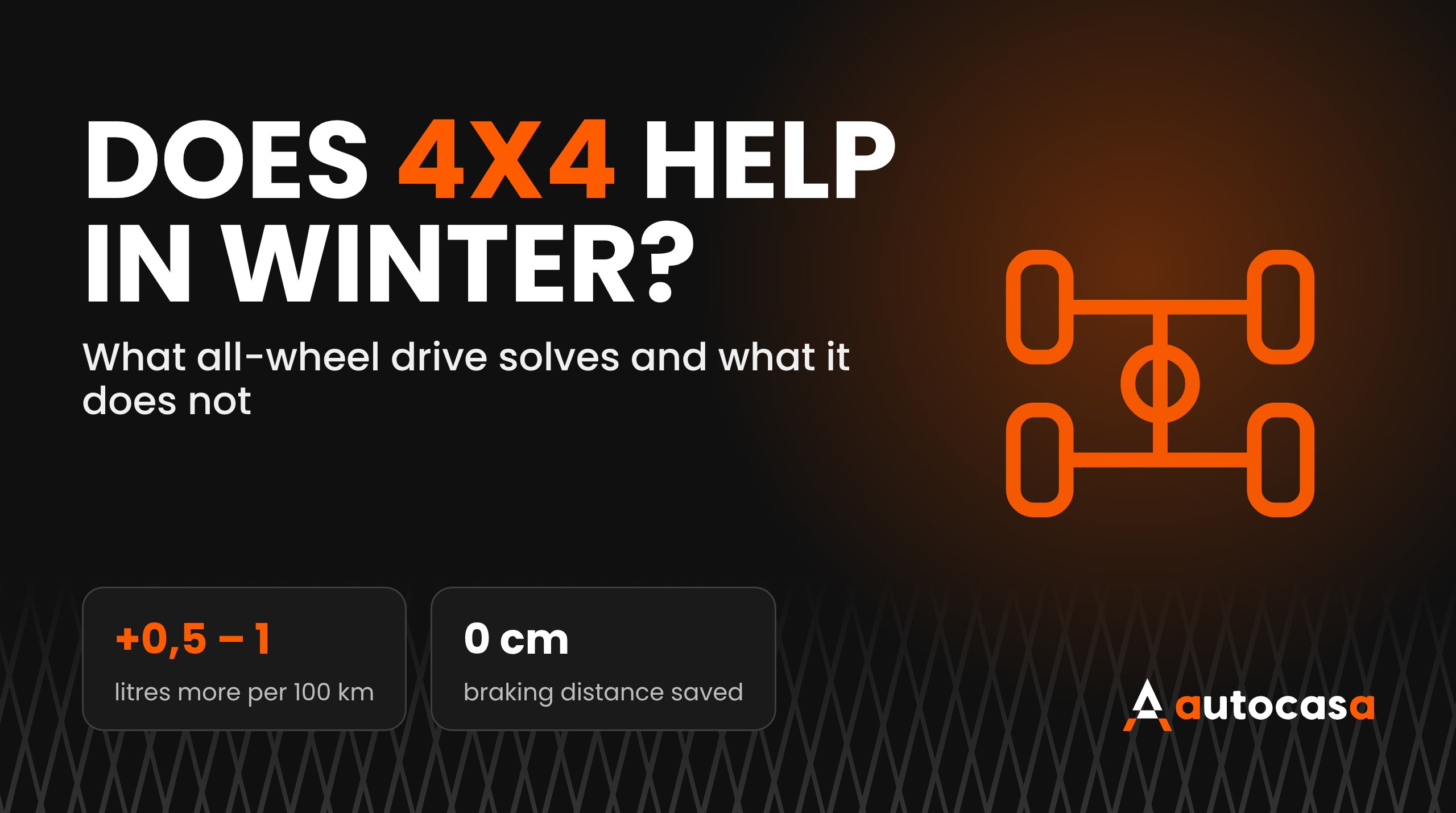
As the first snow approaches, interest in used cars with all-wheel drive climbs in the listings. In Central Europe, 4×4 has a reputation as winter insurance: whoever has it will get up any hill. The reality is more nuanced, and before buying a used car in Slovakia or Czechia it pays to know what all-wheel drive actually solves, what it does not solve at all, and what its upkeep costs on top.
What all-wheel drive really does in winter
All-wheel drive solves one specific thing: putting power down when pulling away. On a snow-covered incline, on an uncleared driveway or on an icy car park the difference is obvious — the wheels spin less and the car moves off where a front-wheel-drive hatchback only scrabbles.
What 4×4 does not solve is braking. When braking on a slippery surface the type of drive plays no role at all — tyre grip alone decides. An all-wheel-drive car on summer tyres stops exactly as badly as a front-driven car on summer tyres. The same applies in a corner: the limit of adhesion is set by the tyre, not by the number of driven axles.
Paradoxically, that is the most common cause of winter accidents involving all-wheel-drive cars. The car pulls away smoothly, the driver gains a false sense of security and arrives at the bend or the junction faster than they can stop. Modern SUVs and electric cars with all-wheel drive often weigh more than two tonnes as well — and more mass means more energy to shed under braking, which means a longer stopping distance.
The law makes no exception for 4×4
If you are buying or selling in Slovakia, § 38 of Road Traffic Act No. 8/2009 Z. z. applies: winter tyres are mandatory when the road is covered by a continuous layer of snow, ice or frost, or when that can be expected given the route and the season. On passenger cars and light vans (categories M1 and N1) winter tyres must be fitted on all axles, not only on the driven ones. All-wheel drive changes nothing here.
The minimum tread depth of a winter tyre on a passenger car in Slovakia is 3 mm (Decree No. 134/2018 Z. z.), and the fine reaches 50 euros on the spot and 100 euros in administrative proceedings. In Czechia the duty under Act No. 361/2000 Sb. applies from 1 November to 31 March, and the minimum tread depth is 4 mm for vehicles up to 3.5 tonnes. Anyone driving in both countries has to meet the stricter Czech requirement.
What all-wheel drive costs on top
A second axle, a propshaft and another differential weigh something and take something too. In everyday use, expect fuel consumption higher by roughly 0.5 to 1 litre per 100 km. With permanent all-wheel drive (quattro, Subaru) the penalty is larger than with controlled-clutch systems, which engage the second axle only when it is needed.
Then there is servicing. The most widespread system on Slovak and Czech roads is the Haldex multi-plate clutch used by the Volkswagen group, Škoda included. On older generations the oil and filter were changed every 60,000 km; from autumn 2008 the maker switched to a three-year interval with no mileage limit. The oil change itself is not expensive — Czech workshops charge around 1,880 crowns, roughly 75 euros.
Neglect is what gets expensive. According to the Auto.cz editorial team, on cars whose oil had not been changed for some 200,000 km the pump had failed in about half of the cases — and a new one costs around 7,100 crowns, close to 280 euros. Cleaning the pump strainer runs to about 50 euros, and flushing a clogged system including labour can cost more still.
What to check when buying a used 4×4
- Clutch service history: ask specifically about the oil change in the Haldex clutch, not just about „regular servicing“. On a car past 150,000 km with no record at all, budget for an extra bill.
- Matching tyres on all four wheels: different rolling circumferences load the system and the clutch wears out needlessly. That is why rotating the tyres roughly every 10,000 km is recommended on a 4×4.
- Rear axle: on multi-link rear axles the eccentric bolts seize. Replacing the arms can cost around 20,000 crowns, roughly 800 euros.
- Test drive in the wet: as you pull away, listen for whether the drive engages without clunks or snatching. A hum that changes with speed belongs to a mechanic.
- Papers and mileage: on pricier used 4x4s, checking the history pays off twice over — repairing the drivetrain is not a small item.
One practical note on the roadworthiness test: brakes are measured on a roller bench, and most stations have rollers for a single axle only. On some all-wheel-drive cars the manufacturer forbids or advises against spinning one axle while the other stands still (Dacia Duster and Suzuki, for example), so the measurement is more awkward. Before buying, it helps to know where nearby a 4×4 can be tested.
Who benefits from 4×4 and who does not
If you live in the hills or on a slope with an uncleared approach, all-wheel drive will save you a great deal of grief and a used 4×4 makes sense. If you drive mainly in town and in the lowlands, put the same 1,500 euros into a good set of winter tyres carrying the snowflake symbol and into honest suspension servicing instead. In safety terms it pays back sooner.
Looking for a 4×4, or selling one?
On AutoCasa you can browse used all-wheel-drive cars on the Slovak and Czech market and sell your own. Listing is free and without any sales commission, promoting a listing is optional and starts at 1.50 euros. Besides cars you will find motorcycles, vans and trucks, buses, trailers, spare parts, wheels and tyres, and bicycles.
If you are selling a used 4×4, state the type of drive, the last clutch service and the tyre condition including tread depth in the listing. That is exactly what buyers ask about, and a listing that answers in advance sells faster.
Information on the winter tyre obligation relates to Slovakia (Act No. 8/2009 Z. z. and Decree No. 134/2018 Z. z.) and Czechia (Act No. 361/2000 Sb.) as in force in October 2026. Other countries apply their own rules. Service prices are indicative.


 Slovenčina
 Čeština
 Angličtina
 Nemčina
 Poľština
 Slovinčina
 Ruština
 Taliančina
 Maďarčina
 Francúzština


Zatiaľ tu nie sú žiadne komentáre. Buďte prvý!