Five kilometres to work, five back, and in winter another ten minutes parked up while the windows defrost. For a used diesel that is the worst possible routine, and November and December are exactly when the particulate filter warning light comes on most often. The repair costs more than a set of winter tyres on rims. Here is how to avoid it, and what to check when you buy a diesel in Slovakia or Czechia.
Why the filter clogs in winter
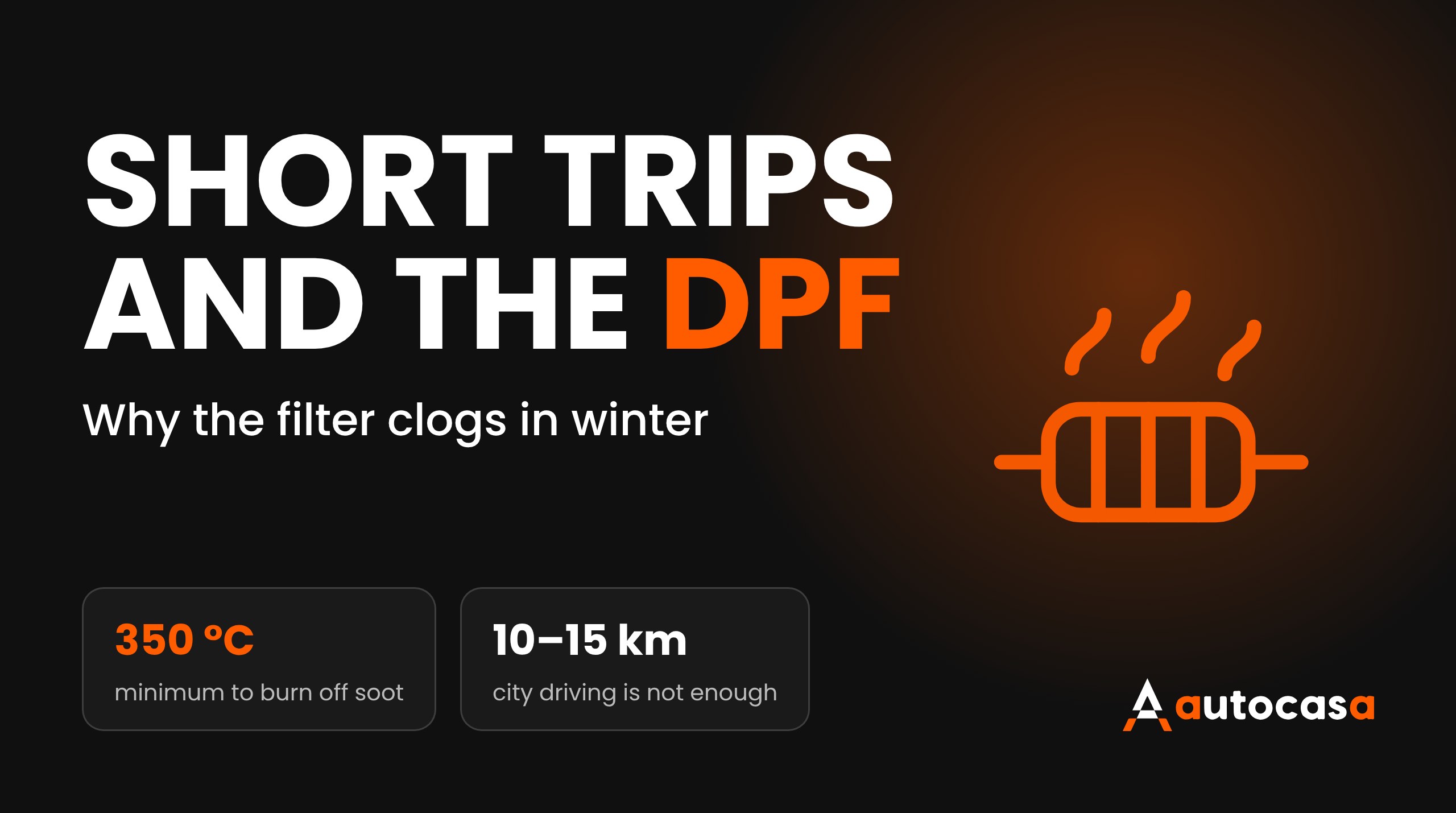
The diesel particulate filter (DPF, or FAP at some manufacturers) traps microscopic soot particles from the exhaust. It is not a disposable canister: the soot is burned off continuously. For that to happen the exhaust has to be hot enough, and passive regeneration starts at roughly 350 °C and above – in other words, on a steady run outside town.
In winter the engine takes longer to warm up, and short urban trips never reach that temperature. Ten to fifteen kilometres in traffic is not enough to burn the soot off. Add a stop-start system that shuts the engine down at every junction and the filter fills faster than it cleans itself.
Once the filter is around 40 to 50 per cent full, the control unit starts an active regeneration: it injects extra fuel to raise the exhaust temperature to roughly 550 to 650 °C and burns the soot away. On newer cars this happens every 500 to 1,000 kilometres and takes 10 to 20 minutes. The worst thing a driver can do is switch the engine off at that moment – the regeneration is interrupted and the soot stays in the filter.
How to keep the filter clear
- One longer run every two weeks: at least 15 to 20 minutes at a steady 80 to 100 km/h, ideally 30 to 50 kilometres on an expressway or motorway. A small detour on the way home is enough.
- Medium revs, not full throttle: the aim is a steadily higher exhaust temperature, not revving the engine out. One gear lower outside town helps more than jerky acceleration.
- Do not switch the engine off during a regeneration. You can spot one by the raised idle, the cooling fan running constantly, a burnt smell and briefly higher fuel consumption. If you notice it outside your house, drive a few more kilometres.
- Oil to the manufacturer’s specification: cars with a DPF need low-ash oils (Low SAPS, typically ACEA C3). Ordinary oil leaves ash in the filter that no regeneration will ever remove.
- Do not defrost the car at idle: at idle the engine warms slowly, burns fuel and the exhaust stays cold. A scraper and ten seconds of effort are better for the car.
The first signs of a clogged filter
It starts quietly: fuel consumption rises by one to three litres per hundred kilometres, there is an occasional burnt smell, and the exhaust smokes more under acceleration. Then the DPF light comes on, the car loses power and in extreme cases drops into limp mode with severely reduced performance.
Watch the engine oil level too. When regenerations keep getting interrupted, some of the injected fuel ends up in the oil, thinning it and reducing its lubricating properties. If the level on the dipstick is rising instead of slowly falling, that is a reason to visit a garage, not to wait.
What it costs depends on how long the problem was ignored. A forced regeneration with diagnostic equipment is usually under 80 €, chemical cleaning without removal starts at around 120 €, and cleaning with the filter removed runs from 150 to 350 €. A new filter is another league: depending on the model, from a few hundred euros to over 2,000 €, plus labour.
AdBlue in the cold
Newer diesels also have an SCR system with AdBlue alongside the filter, and the solution freezes at about -11 °C. That is not a fault – the tank and lines are heated, and once thawed the fluid is perfectly usable. The trouble starts if the canister is frozen solid in the garage when you need to top up: the recommended storage range is 0 to 30 °C, out of direct sunlight.
What to check on a used diesel
- How the car was used. Low annual mileage plus a city address is exactly the profile that wears a filter down. A car with plenty of motorway kilometres has the better history here.
- Ask for a cold start. Agree in advance that the car will be cold when you arrive. A warm engine hides a difficult start and smoke.
- Warning lights once it is warm. Drive at least twenty minutes, including a stretch of expressway, and watch for the DPF or engine light.
- Oil on the dipstick. A diesel smell in the oil and a level above maximum are suspicious, as is oil changed „a few days before the sale“ with no entry in the service book.
- An OBD scan. A cheap reader or a garage will tell you more than the advert: filter load, the number of regenerations and distance since the last one, ash content and stored DPF faults.
- A look underneath. A fresh weld or a surprisingly clean spot on the exhaust, missing pressure sensors and disconnected wiring all point to a filter that has been cut out.
A removed filter is a problem, not a saving
Cutting the filter out and remapping the control unit is still offered by some independent garages as a „permanent fix“. In Slovakia a vehicle modified that way is not fit for road use: under § 44 of Act No. 106/2018 Z. z., a vehicle is also unfit if it does not match its approved type or has been subject to unauthorised intervention. In Czechia, Act No. 56/2001 Sb. treats such a car as technically unfit, and the owner faces a fine of up to 50,000 CZK.
Emission testing no longer looks only at smoke opacity: stored fault codes and the state of the engine warning light count too. A car that has been „sorted“ can therefore fail its test – possibly only after you have bought it and registered it at home.
Diesel, petrol or something else for city driving
If most of your driving is short urban trips, a diesel is the wrong choice – not because it is a bad engine, but because you will never use it the way it needs to be used. For that pattern it is worth looking at petrol, hybrid or electric cars instead. On AutoCasa you can filter the Slovak and Czech listings by fuel and mileage and compare a car’s profile with your own daily routine.
If you are selling a diesel and had the filter cleaned, say so in the advert and attach the receipt. That is precisely the detail that decides between „I will keep looking“ and a viewing in the diary. Listings on AutoCasa are free, with no sales commission and no limit on the number of adverts – alongside cars there are motorcycles, vans and trucks, buses, trailers, spare parts, wheels and tyres, and bicycles. Promoting a listing is optional and starts at 1.50 €.
The regulatory information refers to Slovakia (Act No. 106/2018 Z. z.) and Czechia (Act No. 56/2001 Sb.) as in force in October 2026 and does not describe the rules of any other country. Repair prices are indicative.



 Slovenčina
 Čeština
 Angličtina
 Nemčina
 Poľština
 Slovinčina
 Ruština
 Taliančina
 Maďarčina
 Francúzština


Zatiaľ tu nie sú žiadne komentáre. Buďte prvý!