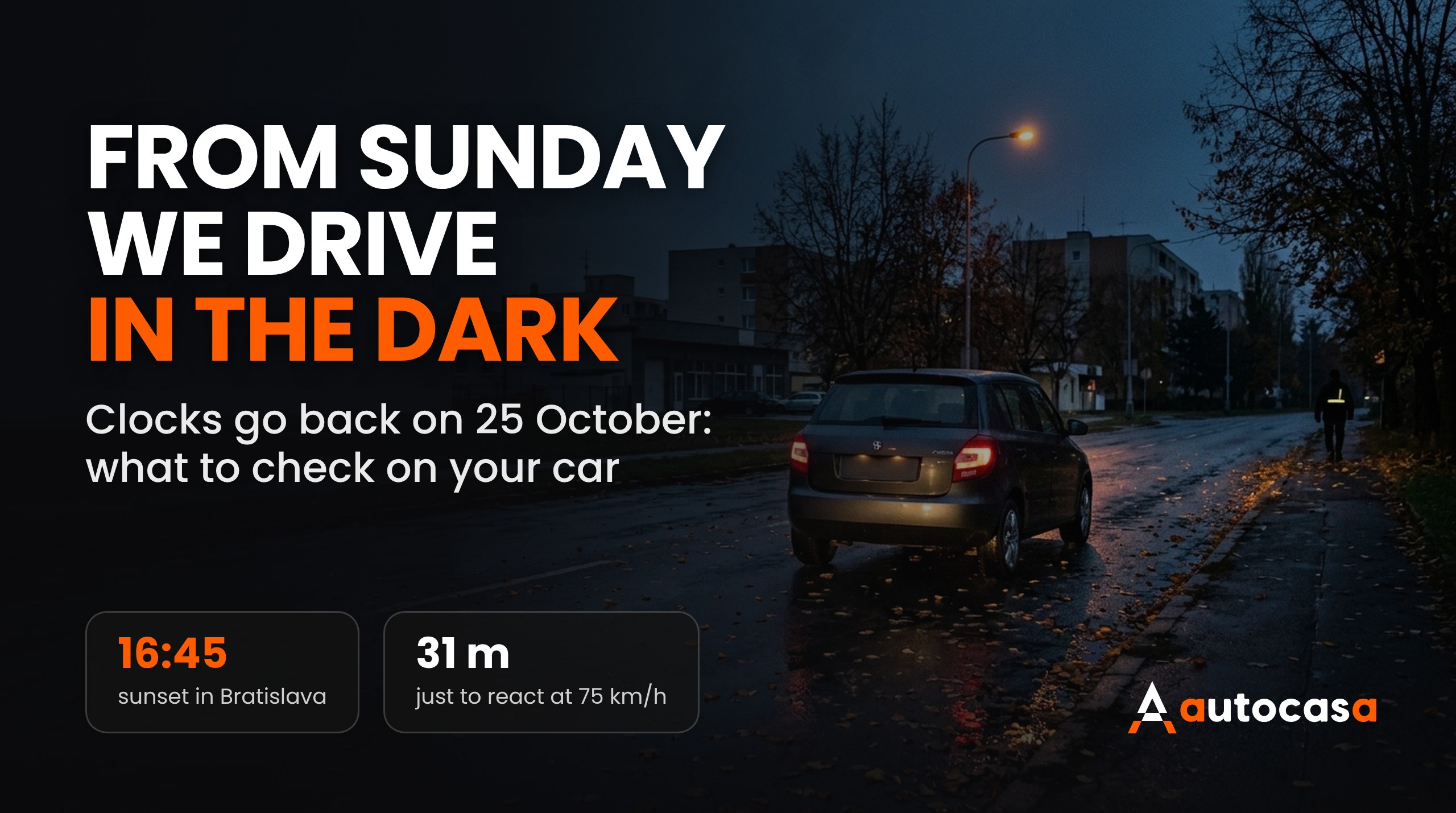
On the night of Saturday 24 to Sunday 25 October, clocks in Slovakia and the Czech Republic go back from 3:00 to 2:00. An extra hour of sleep, but by Sunday evening the real consequence is obvious: for the next six months, the drive home from work happens in the dark. If you drive, buy or sell a car in this part of Europe, one evening of preparation pays for itself.
What exactly changes on Sunday night
Summer time ends on the last Sunday of October, which this year falls on 25 October 2026. Clocks move back from 3:00 to 2:00 and the night is an hour longer. In Slovakia the rule sits in Government Regulation No. 522/2021 Z. z. on summer time for the years 2022 to 2026; in the Czech Republic and across the European Union the switch happens at the same moment, so there is no time difference to watch for at the border.
The difference is immediate. In Bratislava the sun sets around 17:47 on Saturday 24 October and already around 16:45 on Sunday. In Košice it is about 16:30, in Prague around 16:52. By mid-November sunset slips to 16:15 and will not move back before February, which means the afternoon rush hour shifts entirely into dusk and darkness for months.
The first week after the change is the worst
Eyes adapt to night driving gradually, which is why the days right after the clocks change are the most demanding. Traffic is still at full afternoon volume, while pedestrians and cyclists are in summer mode: dark clothing, no reflective elements.
Slovak police published the numbers: by the end of November 2025, 51 pedestrians had died on Slovak roads, 21 of them in reduced visibility. Only three were wearing reflective elements; 35 were in dark clothing. Czech police add a sobering calculation: at 75 km/h a driver needs at least 31 metres (roughly 1.5 seconds) simply to recognise a hazard and react. Braking distance is added on top of that.
What to sort out on the car before Sunday
- Every light, one by one: side lights, low beam, high beam, indicators, brake lights and reverse light. A single dead bulb changes how others see you, and it costs a few euros.
- Clean headlights: a layer of autumn grime and road salt costs more light output than most drivers expect. Wipe them at every fill-up.
- Glass from the inside: the greasy film on a windscreen turns every street lamp into a starburst and badly degrades vision into oncoming light. A degreaser and a microfibre cloth are enough.
- Wiper blades and winter washer fluid: smears blind you after dark. Blades that chatter should be replaced before the first frost.
- Headlight aim: after a bulb change, or with a loaded boot, check the beam height. Badly aimed headlights dazzle oncoming drivers and shorten your own view.
Driving after dark: three things people forget
Match your speed to visibility, not to the sign. The rule is simple: you must be able to stop within the distance you can actually see. On an unlit road outside town, on low beam, that is considerably less than you are used to in daylight.
When you are dazzled, do not move your eyes to the middle of the road but to its right-hand edge, and steer by the verge. Remember too that autumn adds wet leaves and standing water: police warn that fallen leaves can make the surface extremely slippery, particularly in bends and under hard braking. Smoother inputs and a larger gap are the answer.
The third thing is fatigue. The extra hour on Sunday does not mean your body is rested on Monday; an early dusk shifts the feeling of „the end of the day“, and it shows on a longer drive after work. On journeys over two hours, plan the break earlier than usual.
Pedestrians and cyclists: the Slovak and Czech rules
In Slovakia, a pedestrian walking on the verge or at the edge of the carriageway in reduced visibility must wear visibly placed reflective elements; police can issue a fine of up to 60 euros. In the Czech Republic the duty applies outside built-up areas, on the verge or edge of the carriageway where there is no street lighting, with an on-the-spot fine of up to CZK 2,000. These are Slovak and Czech rules; your own country will have its own.
For a driver, the physics is what matters: at night reflective material is visible from roughly three times the distance of white clothing and more than ten times that of dark blue. It works best on a moving part of the body, above the wrist or above the ankle.
Buying or selling a car? Darkness changes the rules
Short days also change how used cars are traded, which matters to anyone travelling to Slovakia or the Czech Republic to view one. Book the viewing in daylight, ideally on a Saturday morning: in the dark, or under a halogen lamp in a garage, you will not see mismatched paint shades, small dents or the corrosion starting on door edges. Even so, keep the car for a few minutes after dusk as well, because that is when a hazed or cracked headlight, moisture inside a lamp, retrofitted LED bulbs in halogen optics or a dead number-plate light will show up.
If you are selling, do not try to photograph the car after work; from Sunday there will not be enough light. Set aside a weekend morning, wash the car and shoot it in daylight from every side, including the interior, the boot and the condition of the tyres. On AutoCasa, listing is free, with no sales commission and no limit on the number of adverts; promotion is optional and starts at 1.50 €. You can list cars, motorcycles, vans and trucks, buses, trailers, spare parts, wheels and tyres, and bicycles – including the summer set that is now taking up space in your garage.
This article draws on Slovak Government Regulation No. 522/2021 Z. z. on summer time for 2022–2026, Slovak Act No. 8/2009 Z. z. on road traffic and Czech Act No. 361/2000 Sb., as in force on 19 October 2026. Sunset times are calculated for Bratislava, Košice and Prague. The rules described apply to Slovakia and the Czech Republic.



 Slovenčina
 Čeština
 Angličtina
 Nemčina
 Poľština
 Slovinčina
 Ruština
 Taliančina
 Maďarčina
 Francúzština


Zatiaľ tu nie sú žiadne komentáre. Buďte prvý!