A flying stone leaves a star the size of a grain of rice on the windscreen, and most drivers put it off until „sometime later“. It is precisely the first frosts and the morning de-icing that turn it into a crack running halfway across the glass within a few days. In summer it is a cosmetic matter; in winter it means the roadworthiness test, a fine, and several hundred euros of difference between a repair and a replacement.
Why a small chip becomes a full-length crack in winter
A windscreen is laminated glass: two panes bonded by a plastic interlayer. A stone strike breaks the surface layer and water seeps into the micro-crack. When it freezes overnight, it expands and forces the crack open from the inside. Add the temperature difference: minus five outside, and the driver turns the heater to maximum straight onto the glass. The pane warms unevenly, and the crack moves at exactly that moment.
A few winter habits that cost nothing: never pour warm water on a frozen windscreen, raise the heating gradually, and scrape with a plastic scraper rather than an improvised card or a key. If you already have a chip, cover it from the outside with clear tape so water and dirt stay out. The repair will then have a far better chance of working.
When a car is not roadworthy under Slovak rules
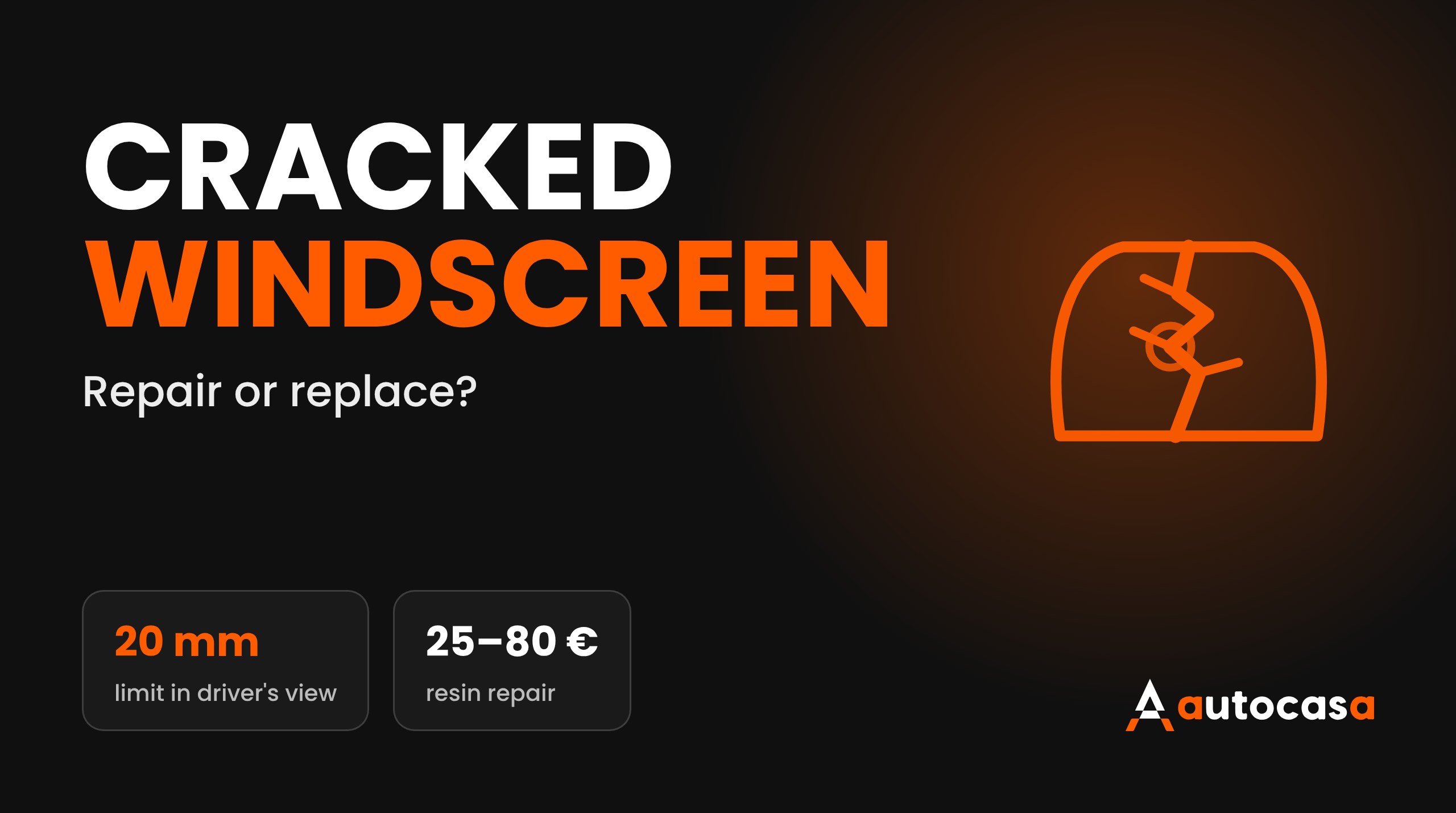
If you drive a car registered in Slovakia, or you are buying one there, it pays to know the local threshold. What matters is the size of the damage and where it sits on the glass. In the driver’s field of vision, meaning the area the wipers sweep directly in front of them, damage must not exceed 20 mm. Outside that area more is tolerated: damage up to roughly 50 mm, and no more than five such spots across the whole windscreen.
Once you cross the threshold, the vehicle counts as technically unfit for operation. In practice that means two things: a police officer can issue a fine of up to 60 € and withhold the registration certificate, and the car will not pass the Slovak technical inspection (STK) with that windscreen. In Czechia the limit is the same (20 mm in the wiper-swept area), but the penalty is harsher: administrative proceedings can reach 10,000 CZK, around 400 €.
Watch out, too, for damage that reaches the edge of the glass. That is where the windscreen is bonded to the body, and a crack at the edge weakens the whole structure. Glass like that is not repaired; it is replaced.
Repair or replace? Size, position and price decide
A resin repair means that resin is pressed into the damage under vacuum and cured with UV light. The glass stays, the crack stops spreading and becomes less visible. It is not cosmetic surgery, though: the mark left by the impact remains visible.
- A repair makes sense when: the damage is outside the driver’s field of vision, no larger than about 2 to 2.5 cm, does not reach the edge of the glass, and is relatively fresh. It takes 30 to 60 minutes.
- Replacement is unavoidable when: the crack is in the driver’s field of vision, longer than 4 cm, reaches the edge, branches out, or there are several impacts at once.
- What it costs: repairing a single spot in Slovakia runs at roughly 25 to 80 €.
- Replacement: older cars without sensors, 180 to 350 €; glass with a rain sensor, 260 to 500 €; heated or acoustic glass, 350 to 950 €. A windscreen with a driver-assistance camera starts at 430 € and exceeds 1,300 € on premium models.
- Third-party liability insurance will not pay for your glass. It covers damage you cause to someone else. Your own windscreen is a matter for comprehensive cover or a glass add-on, with an agreed limit and a deductible. Report and photograph the damage before the repair, otherwise the insurer may refuse to pay.
One thing follows from those numbers: a 40 € repair and a 600 € replacement are not comparable items. So a chip on the windscreen is not something that waits until spring.
New glass with a camera needs calibration
Cars built in the past decade have a camera behind the interior mirror, feeding lane keeping, traffic-sign recognition and automatic emergency braking. The camera is mounted on the glass or on its bracket, so after every windscreen replacement its viewing angle shifts: by millimetres the eye cannot see, but enough for the system to work from the wrong geometry.
Manufacturers therefore prescribe calibration of the assistance systems after every windscreen replacement, without exception. In Slovakia it costs roughly 80 to 220 €, and it is not an optional extra: without it, emergency braking may react late or for no reason, and a fault code in the system can also be held against you at the technical inspection. When you book the replacement, always ask separately whether calibration is included in the price.
The glass also tells you something about a used car’s history
When you go to look at a used car, whether in Slovakia, in Czechia or as an import, the glazing is one of the cheapest and quickest clues to its past. In the corner of each pane there is a marking: the car maker’s brand or the glass maker’s name, the approval mark with the letter E and the code of the country that approved the glass, and a code with the year of manufacture. On factory glazing you will find the same maker on every pane, with dates close together.
So walk around all the windows and compare them. One pane from a different maker, or with a markedly later year, has been replaced. On its own that is no reason to walk away; half the cars on the motorway have had a windscreen changed because of a stone. The warning sign is when two or three panes on the same side of the car are new, when there are traces of fresh sealant around them and resprayed pillars, or when the boot and the floor under the carpet are damp. At that point you are no longer talking about a stone, but about an impact. Ask as well whether the assistance systems were calibrated after the replacement: on a car with a camera, that is a fair question.
Selling or looking? A listing that hides nothing helps
If you are selling the car and the windscreen was changed a year ago, put it straight into the listing, along with whether calibration was done. The buyer will notice during the viewing anyway, and a fact stated openly looks better than one discovered. The same goes for a small chip outside the field of vision: add a photo and note that it has been resin-repaired.
On AutoCasa, listings are free, with no sales commission and no limit on the number of ads; promoting a listing is optional and starts at 1.50 €. Besides cars you will also find motorcycles, vans and trucks, buses, trailers, spare parts, wheels and tyres, and bicycles. So if a set of wheels or parts from a previous car is left in the garage after the winter season, there is somewhere for them to find a new owner.
Information on the technical requirements is based on Slovak Decree No. 134/2018 Z. z. on the operation of vehicles in road traffic and Act No. 8/2009 Z. z. as in force in October 2026, and the Czech figures on Decree No. 341/2014 Sb. These rules apply in Slovakia and in Czechia respectively. Prices are indicative Slovak market figures as of October 2026 and vary by model and region.



 Slovenčina
 Čeština
 Angličtina
 Nemčina
 Poľština
 Slovinčina
 Ruština
 Taliančina
 Maďarčina
 Francúzština


Zatiaľ tu nie sú žiadne komentáre. Buďte prvý!