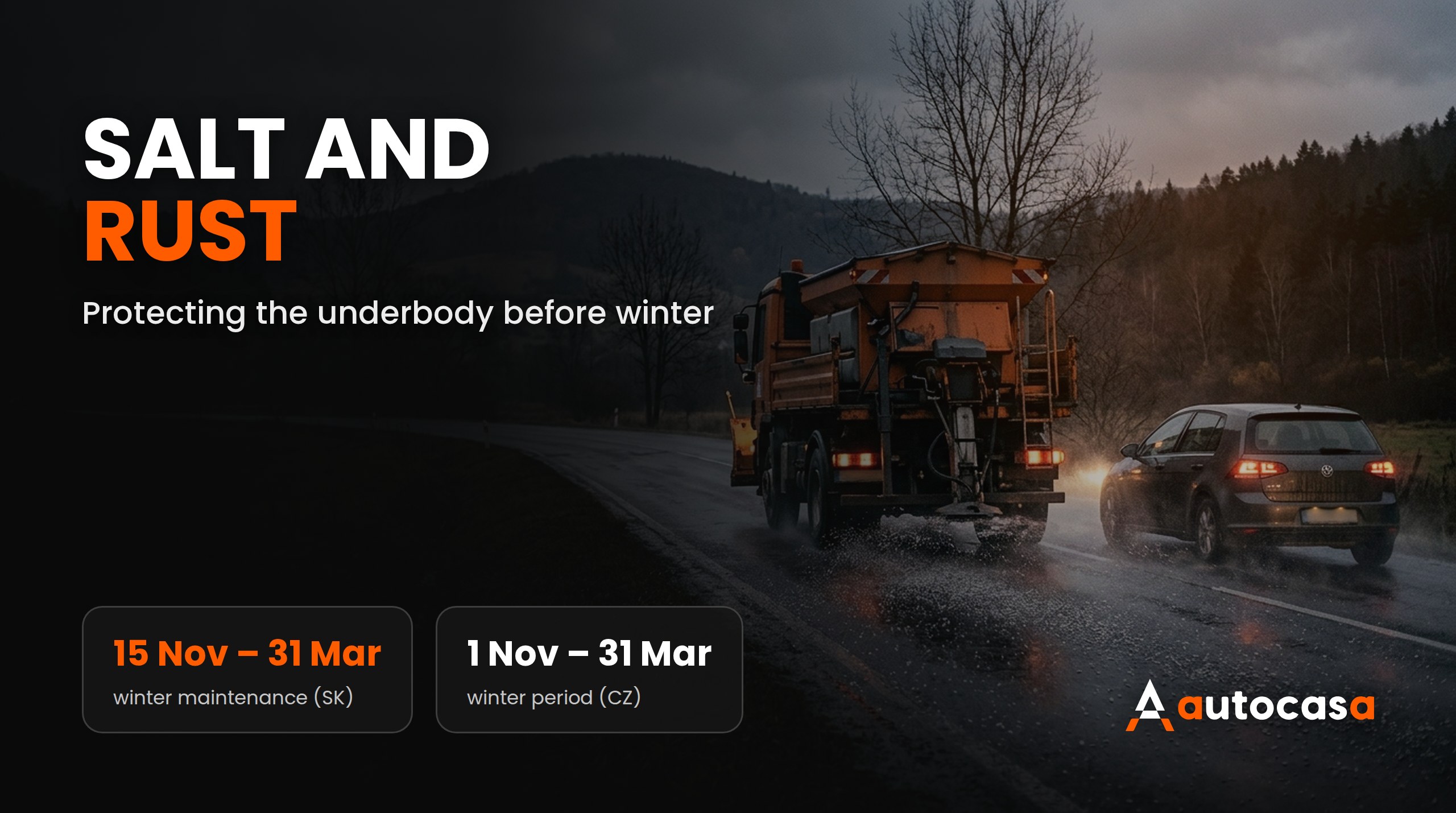
In a few weeks the first gritters will roll out onto Slovak and Czech roads, and with them begins the worst time of year for the metal under your car. Salt alone does not destroy a car — inaction does. A few hours of work in October can save you a sill repair that costs more than a full set of winter tyres.
When the salt reaches the roads
In Slovakia road authorities usually declare the winter maintenance season from 15 November to 31 March, the exact dates driven by the weather. In Czechia the winter period is set by Decree No. 104/1997 Sb. from 1 November to 31 March. Crews use road salt and inert material, most often dolomite chippings; on some stretches, such as water protection zones, chemical treatment is ruled out entirely.
In practice that means one thing: you have until roughly mid-November. Anyone who waits for the first snow is already washing a car that salt has been working on for days. These dates apply to Slovakia and Czechia — your own country will have its own rules.
Why salt is so damaging
Salt does not eat through steel directly. Dissolved in water it forms an electrolyte that speeds up ordinary corrosion, and it lowers the freezing point, so a wet slurry stays on the underbody even below zero. Dry frost is neutral for the bodywork; the salt solution in a wheel arch works non-stop all winter.
The worst-affected spots are those where moisture lingers and airflow never reaches:
- Wheel arch lips and lower door edges – the first place bubbles appear under the paint.
- Sills and their inner cavities – they rust from the inside out, so nothing shows on the outside for a long time.
- Wheel housings and plastic liners – a wet mix of salt and mud collects underneath and never dries on its own.
- Brake and fuel lines – thin-walled pipes where corrosion is a safety issue, not a cosmetic one.
- Springs, dampers and suspension arms – a corroded spring snaps in winter more often than drivers expect.
- Drain channels under the bonnet and in the boot – clogged with leaves, water sits directly on the metal.
What to get done before the first gritting run
- Wash the underbody thoroughly while temperatures are above freezing and the metal still has time to dry. Summer dust mixed with sand holds moisture just as well as salt does.
- Inspect the underside with the car raised. Flaking old underseal or blisters on the sills are a reason to act now, not in spring.
- Touch up paint chips. Every scratch down to bare metal is an open door; a touch-up pen for a few euros is the cheapest rust protection there is.
- Clear the drain channels around the windscreen, under the bonnet and in the spare wheel well, and treat the rubber seals with a silicone product.
- Check the wheel arch liners. A missing or torn clip means everything gets in underneath and nothing gets back out.
Rustproofing: who it pays off for
Professional wax treatment of the underbody and cavities is not cheap. In Slovakia the basic programme — underbody plus cavities — starts at around 530 € including VAT for an ordinary car, the full package with engine bay and exhaust from about 610 €; SUVs and vans cost more, and existing rust is charged on top. In Czechia comparable packages start at the equivalent of roughly 560 €, and the car spends four to six days in the workshop: it has to be washed, dried properly and only then sprayed.
The arithmetic is simple. On a two-thousand-euro car with blisters already on the sills, the investment makes no sense. On a four- to eight-year-old car you plan to keep another five years it almost always pays back: a clean underbody is the first thing an experienced buyer checks, so it shows up in the resale price too.
On newer cars, keep the factory warranty in mind. Škoda, for instance, quotes a 12-year warranty against body perforation and three years on the paint. It covers only rust-through from the inside out and is usually tied to regular servicing at an authorised workshop. If the car is still covered, check the terms before having the underbody sprayed elsewhere.
Washing in winter
If you drive daily, the usual advice is to wash the car every one to two weeks, and more often after days of heavy gritting. Always add the underbody programme — that is where salt lingers longest.
A few practical rules: never pour boiling water on frozen glass or paintwork; after washing, blow out the seals so locks and rubbers do not freeze shut; and in hard frost below minus ten, leave the wash for a milder day. A layer of hard wax applied back in autumn makes every later wash noticeably easier.
Rust when buying a used car
Autumn and winter are a good season to buy a used car. The cars are dirty and wet, and that is exactly why they tell you more than a polished example in summer sunshine. Corrosion is also one of the few faults that cannot be hidden quickly.
When you view a car, shine a torch into the wheel arches and along the sills, and check the inner edges of the doors and tailgate too. Distinguish between two findings: surface corrosion on the bodywork is normally only a minor defect at the Slovak roadworthiness test, whereas corrosion of load-bearing parts — sills, floor pan, suspension arms and their mounting points — is a reason for the car to fail. A rusted-through brake pipe is equally dangerous.
Watch out for the opposite extreme too: a freshly sprayed black underbody on a fifteen-year-old car can be an attempt to paint over something. Ask when and where it was done and, if you can, have the car looked at on a lift. Forty euros for an inspection is cheaper than the first discovery a year later.
If you decide to sell
If you are planning to sell before winter, a washed and treated underbody pays you back both in price and in how fast the car goes. And if a seasonal tyre change or a repair has left parts, wheels or a set of tyres sitting in your garage, you can pass them on through AutoCasa: listing is free, with no commission on the sale and no limit on how many adverts you post. Promoting a listing is optional and starts at 1.50 €.
You can list cars, motorcycles, vans and trucks, buses, trailers, spare parts, wheels and tyres, and bicycles. With a used car it is worth adding photos of the underbody and sills: you save yourself half the questions, and a buyer who can see you have nothing to hide turns up far more decided.
Winter maintenance dates come from the road authorities‘ plans in Slovakia (as a rule 15 November to 31 March) and from Czech Decree No. 104/1997 Sb. (1 November to 31 March), as in force in October 2026. These rules apply to Slovakia and Czechia. Prices are indicative and vary by workshop and scope of work.




 Slovenčina
 Čeština
 Angličtina
 Nemčina
 Poľština
 Slovinčina
 Ruština
 Taliančina
 Maďarčina
 Francúzština


Zatiaľ tu nie sú žiadne komentáre. Buďte prvý!